
Hello there and welcome to my seventy-first blog.
I hope you are all having a wonderful month of kindness.
My interest in breathing and breathwork post varsity (having learnt the basics during my physio degree) was piqued initially whilst working in the UK, treating patients’ post-cardiothoracic surgery, and post-transplant surgery. It was imperative that these patients learned breathing exercises to help enhance and maximize their lung capacity.
This knowledge served me well until the Covid pandemic struck. I have been referred several patients post their Covid infection and so I started reading and researching to improve my knowledge in this area and to familiarize myself with the techniques therapists are now using worldwide to treat Covid-infected patients and patients suffering from post-Covid respiratory complications.
In my further exploration of this field, I stumbled across breath awareness and conscious breathing and the invaluable use of these for mental and emotional health, including deep breathing as a form of mediation, that practice which seems to be the veritable thorn in my proverbial side.
This is a huge, immense, and vast subject and from the Get-go I just need to say that this blog is just a very small tip of the iceberg. It is merely an introduction to proper breathing.
As we all know, breathing is the process of taking air into and expelling it from the lungs. Breathwork refers to any type of breathing exercises or techniques and has become a very popular catch phrase throughout the world. It has its roots in many of the ancient wisdom traditions and has been used for many years throughout the world in different cultures, creeds, and religions. Conscious or mindful breathing is an umbrella term for methods that direct awareness to the breath.
So many words, so let us try to keep it simple.
A person at rest takes about 16 breaths per minute. We breathe about 960 breaths an hour, 23 040 breaths per day and 8 409 600 per year. If we live to 80, we will take 672 768 000 breaths throughout our lives. How unbelievable is this, and we just take it for granted!
We can survive many days without food and three to four days without water before irreversible damage occurs. However, we can only go a few minutes without breathing, most of us four or five minutes before irrevocable brain injury occurs. The world record holders for free diving can halt their breath for about seventeen minutes. Breathing is vital and our breathing pattern is one of our most basic processes.
Breathing is It is one of the many rhythms that make up our life. Our heart beats sixty-five to seventy-two beats per minute We have nervous system rhythms, circadian rhythms, sleep and wake cycles, digestive rhythms and women have menstrual cycles, to name a few.
Our breathing pattern is one of the only patterns of our physiological systems that we can access directly, and we can change, and this has a profound effect on other systems. A few minutes a day of controlling our breathing pattern will impact our other patterns and enhance our physical, emotional, and cognitive processes. Our breath reflects everything that is happening physiologically, physically, psychologically within us. By changing the breath, we can change what is happening within our bodies. Most of us do not breathe deeply and many of us are chronic chest breathers. Plenty of common habits lead to shallow breathing which can lead to feelings of stress and anxiety. Chronic busyness on one hand and a sedentary lifestyle on the other results in us not using our lungs to their full potential. We need to change this
Let us examine exactly how breathing takes place in our body.
The process of breathing simplified.
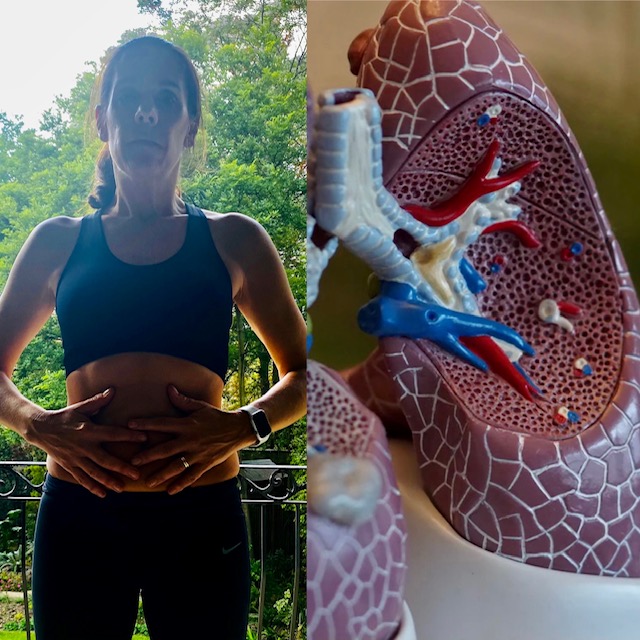
The diaphragm is a large muscle that sits at the base of the lungs. When you inhale, your diaphragm contracts and moves downward, creating space for the lungs to expand and fill with air. The muscles between your ribs called the intercostal muscles, contract to pull your ribcage upward and outward. As your lungs expand, air is sucked through your nose and mouth and travels down your trachea to your lungs. After passing through your bronchial tubes, the air finally reaches the air sacs where oxygen is passed into the blood stream. At the same time carbon dioxide travels into the air sacs from the blood stream and is expelled from the body as you exhale. When a person exhales, the diaphragm relaxes and moves upward, helping move air out of the lungs.
What are the benefits of proper breathing?
- Breathing increases the supply of oxygen and nutrients to cells throughout the body and increases the supply of blood and nutrients to muscles blood and bones.
- It relaxes muscle spasm and relieves muscular tension.
- Breathing may reduce your blood pressure and lower your heart rate.
- It improves your body’s ability to tolerate intense exercise.
- Breathing improves your posture.
- It enhances relaxation and improves your sleep.
- Breathing may enhance learning and cognitive performance.
- It may improve your balance.
- Breathing slows your rate of breathing so less energy is expended.
- Breathing can help train the body’s reaction to stressful situations. When we breathe rapidly our fight and flight response is activated, the sympathetic part of our autonomic nervous system nervous system. We have spoken about this often. Slow deep breathing stimulates the parasympathetic response, the rest and digest one, calming you down. This will result in the release of more endorphins which will enhance feelings of natural wellbeing.
- Using breathing as a focus we may be able to alter the basic activity of our cells with our mind. By using our mind to change your body, we may be able to change the expression of our genes.
- Breathing is the basis of many meditations.
Wow! So many benefits and all right under our noses!!!! So, how can we enhance our breathing pattern?
I am only going to discuss two basic practices today, breath awareness and belly or diaphragmatic breathing There are fifty or more of these practices. Last year I did a video on diaphragmatic breathing for one of my blogs. Have a look at it if you like.
There are many descriptions for these practices. I have just chosen the one that I find easiest.
1st practice.
Breath awareness.
Sit or lie down in a relaxed, comfortable position, with your back straight, feet flat on the floor and hands flat on your lap. Relax your shoulders, jaw, and face. Close your eyes or keep them open with your head up and your gaze focused ahead.
Bring your awareness to your breathing. Just think about your breathing.
Try to breathe in and out through nose or in through your nose and out through your mouth. Feel the breath coming in and then going out for one minute.
Then gently extend your breath; inhale and exhale your breath for one second longer.
Enjoy the sensation, as you would your favourite song or food,
Relax the breath and open your eyes.
2nd practice.
Abdominal breathing.
Sit or lie down, with your knees bent in a relaxed, comfortable position with your back straight and your feet flat on the floor.
Place your thumbs on the lower part of your ribs with your baby fingers on your hip bones and your other two fingers close to your navel.
As you inhale, you will feel your belly expanding and as you exhale you will feel your belly relaxing.
Breathe gently into your belly and feel it rising and falling. You may also feel your ribs moving under your thumbs. Do not be concerned about the length of your inhale and exhale.
Breathe gently into your belly which rises as you inhale and comes down as you exhale. may feel ribs moving under thumbs. Don’t be too concerned about length of inhale and exhale.
Continue this practice, establishing a natural rhythm as your belly rises and falls. Give yourself the space to repeat the breaths until you feel yourself relax.
There are a few versions of this belly breathing and various practitioners adopt different nuances of this breathing. You may find that a different method is easier or works better for you.
In conclusion, I have learnt an incredible amount about breathing recently. I have bought books and am studying and researching constantly. Breathwork has become one of my passions. There is a minefield of information out there, and some conflicting and contrasting theories on this massive subject. Although this ancient practice of has been around for centuries, science is only recently started providing evidence that the benefits of this very old practice are real.
My hope for you all is that you can become a little more aware of your breath and that this ultimately helps to enhance your health and wellness. Should you wish to explore this further and learn more breathing practices, please do not hesitate to contact me.
So, friends, go out there and breathe properly!!
Wishing you all a stunning weekend.
With thanks to Herbert Benson, Tim Jewell, and Eddie Stern.
Here’s to better breathing.