
Hello there and welcome to my 101 st blog.
Thank you for all your positive and awesome messages sent following the publishing of my 100 th blog.
They all meant so much to me.
I have spoken and continue to speak often about kindness and my mission to try to do an act of kindness every day. However, the word compassion has only became a part of my life, particularly my working life, more recently.
When I took over Karen’s practice three years ago, little did I know, that the most significant aspect of my treatments, would be both being kind and compassionate.
Obviously the actual “physical” therapy that I do is also very important, but for the most part, of equal, and, in fact greater importance, were being friendly and considerate (kind) and being sympathetic and then wanting to help ease their discomfort or pain (compassion).
It has only been on recent reflection that this has dawned on me. However, there are other things I want to chat to you about before we embark on this compassion theme.
Although I wax lyrical, often and repetitively, about how much I love treating the more mature folk, this has not come without its trials and tribulations. My learning curve, oft repeated, has been steep and arduous.
Let me expand upon some of the practical aspects of this.
- I clashed with a few folks in power in the very early days at one of the homes mainlt due to Covid fears, beyond career limiting at the time, but not at all in retrospect.
- I have had the odd issue with some relatives for a number of different reasons.
- I have had to learn so much about the workings of retirement homes and the pecking order of staff and carers. The rules and regulations differ from home to home, as does the management style. I learnt very quickly that I needed to be very careful about expressing my opinion. A very good learn for me.
- The actual physical therapy that I was doing with my new elderly folk was very different from anything I had ever done before. Whilst studying, we did not have any practical blocks treating and caring for the elderly.
- Then there are, on one end of the spectrum the surgeons who have specific protocols following varying orthopaedic surgeries, and then on the other end, those folk who return to frail care or their homes with no post-surgery discharge instructions at all.
- My area of specialization has always been musculoskeletal, and not really orthopaedic, and I had barely ever treated folk post their total hip replacement or total knee replacements, not to mention ankle or foot surgeries. I am now very comfortable treating most of these, but am still cautious, mindful, and careful when doing this.
- I also have never been the first person to assess a patient following their fall and have had to learn to do this, quite a responsibility, I might add.
- Learning to fall proofing folks’ homes has been an exciting endeavour for me, but it still does tax my brain at times.
- My feelings that a number of my patients are overmedicated has been an increasing concern of mine, and one that I am trying to manage and assist my patients and their relatives with.
I have found the mental and emotional side of treating the more mature folk quite challenging at times, too. As I mentioned above, beng kind and having compassion have become an integral part of my work. As I have said before, I am not a naturally kind person, but I work hardon doing kind things and trying to make the world a better place. I also try to be helpful and thoughtful. I think I am caring, but this can be inconsistent. I can be mean at times, maybe more in my thoughts than my actions, but nonetheless, this is true. I feel compassion for my patients, but perhaps not as consistently as I would like.
This led me to thinking that perhaps I can enhance these “skills”.
A little reading and some research later, I stumbled across a strategy that has been developed by the National Health Service Commissioning board in the UK.
Long story, short. This strategy was developed to create a set of common values to try to provide consistent high-quality care to both patients, employees, and all health care providers.
Six areas of action were identified which are essential for providing this.
These are the 6 C’s, referred to as Compassion in Care.
I have amended the explanation of these for the purpose of my blog.
- Care
From a personal perspective, I I need to listen to my patients wishes, consider their beliefs, treat them with dignity and work in their best interests. This can be quite hard, as an increasing number of my patients have memory issues, senility or Alzheimer’s and they are unable to express their needs or wishes. I am learning and will continue to do so, that I need to just take time to pick up on cues, to be patient with them, and to try to keep them calm and contented. A labour in progress.
- Competence
Shoo, this was initially quite a daunting one for me. This means having the expertise, clinical knowledge, and technical knowledge to deliver care treatments that are effective and based on research and evidence. From the get-go, I started reading, studying, and researching the various aspects of this new field, fortunately I had the time during covid and got pretty much up to speed on this relatively quickly. I continue to read and learn, and I am certain I will do this forever.
- Communication
Just as I think I have this completely sorted; I find that perhaps I am not perfect in this department! I send messages and videos to patients’ relatives who live abroad or in another town, I communicate with the matrons and sisters in charge, I write the perfunctory reports or letters to other healthcare providers, and I remind patients of their appointments. Where perhaps I can improve and work upon, is the listening properly consistently to my patients, and picking up on nonverbal, very necessary, skills. At the start of each treatment, I usually tell them what we are going to do and often give them a few choices, if they are able to communicate adequately with me. Through the treatment I ask how they are doing and am acutely aware of any changes in their vital signs or any obvious fatigue or pain.
- Courage
This means doing the right thing, speaking up when I have concerns and having the strength and courage of my convictions to be innovative, to change things up, and to be ethical and honest. This has to be done with a certain degree of diplomacy, and I seem to have learnt that. The Hayles, who shoots from the hip and sometimes does not have the greatest control of the sometimes-nasty words that roll so easily off her tongue, may actually be growing and maturing!! I always try to look at the story from all the sides, the patient, the carers, the matrons, and the relatives, which can make for a complicated time. However, my patient always comes first. This is an ongoing work in progress.
- Commitment
My patients and their care need to be my priority whilst I am treating them, and also before and after. Creating exercise programmes, communicating with their carers and relatives are just as important as the actual physical therapy that I give them. I also need to be vigilant whilst treating them. Falling and fall prevention has become a big part of my life, and I am always beyond nervous that one of my patients will fall whilst I am treating them. This total consistent commitment can be quite onerous.
- Compassion
I briefly mentioned the importance of compassion above. Compassion means delivering care with empathy, respect, and dignity, and recognizing people’s emotions and empathizing with them. I need to be constant in recognizing my patient as a human being and not just someone I am trying to take care of and help. I do not struggle with this.
When my patient literally rapped me over the knuckles with her hairbrush, it was not because she did not like me, it was because my moving her stiff stroke arm was painful, and she was frustrated. Also, when a patient felt that I was going to cause her to fall, it was not the case, but it was her fear that she might, which caused her to dislike physio. I was quite upset after both incidences, but later tried to visualize what they both must be going through. This definitely helped me, and perhaps it was due to the empathy I felt for them.
Last week, when one of my favourite patients took a tumble, I went the extra mile for him, without giving it a thought. He turned to me on Thursday and said, “Hayley, you are a wonderful friend, a real friend”. This was just the very best. Needless to say, it bought big tears to my eyes when I got back into my car having seen him. I think he really appreciated my showing him true compassion, and seeing him as friend, and not just a patient.
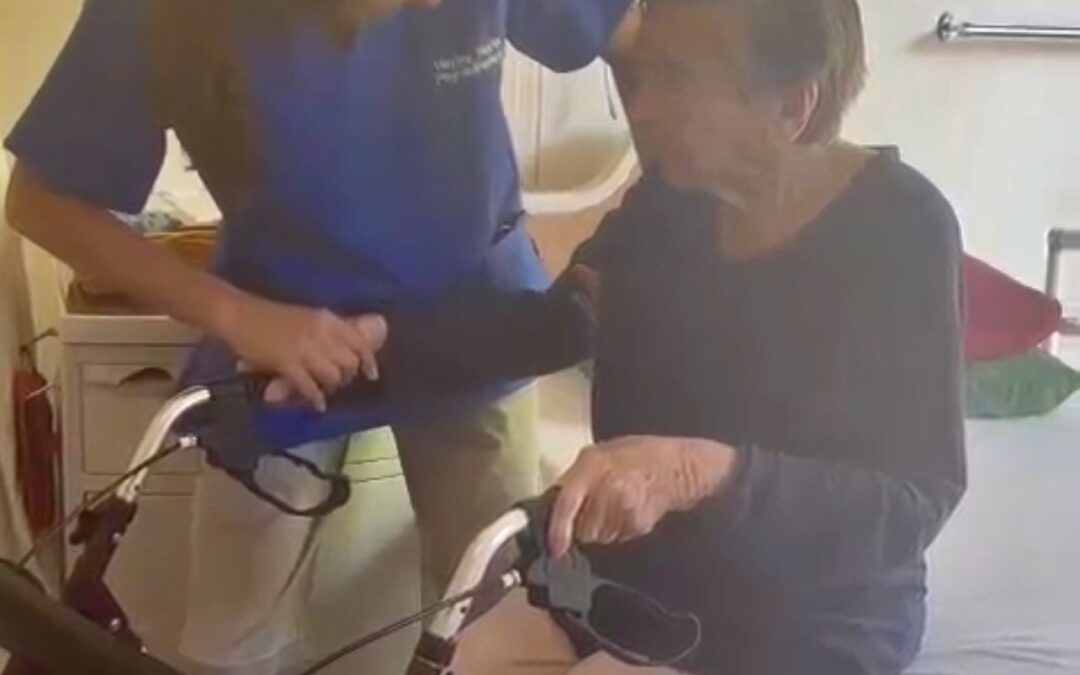
However, for me compassion encompasses so much more. It’s about patience when a patient just wants to brush her teeth before treatment, it’s about a hug when i see someone is feeling vulnerable, it’s a High-Five when my patient manages to walk to breakfast with her assistive device, it’s about giving time when a patient is trying to tell me something and the words are getting muddled and it’s about huge smiles that radiate from ear to ear. It’s about a laugh when I crack a silly Dad joke (apologies to the chaps), and it’s about concentrating totally and utterly on that person whilst I am with them. It’s about friendship and love and understanding and respect.
Thank you for listening to my rambling once more. Mostly my thoughts, with a little help from the NHS.
I just want to end reminding you that it is just as vital for you to be kind and compassionate to yourselves as it is to be to others.
Wishing you a wonderful week.
+