
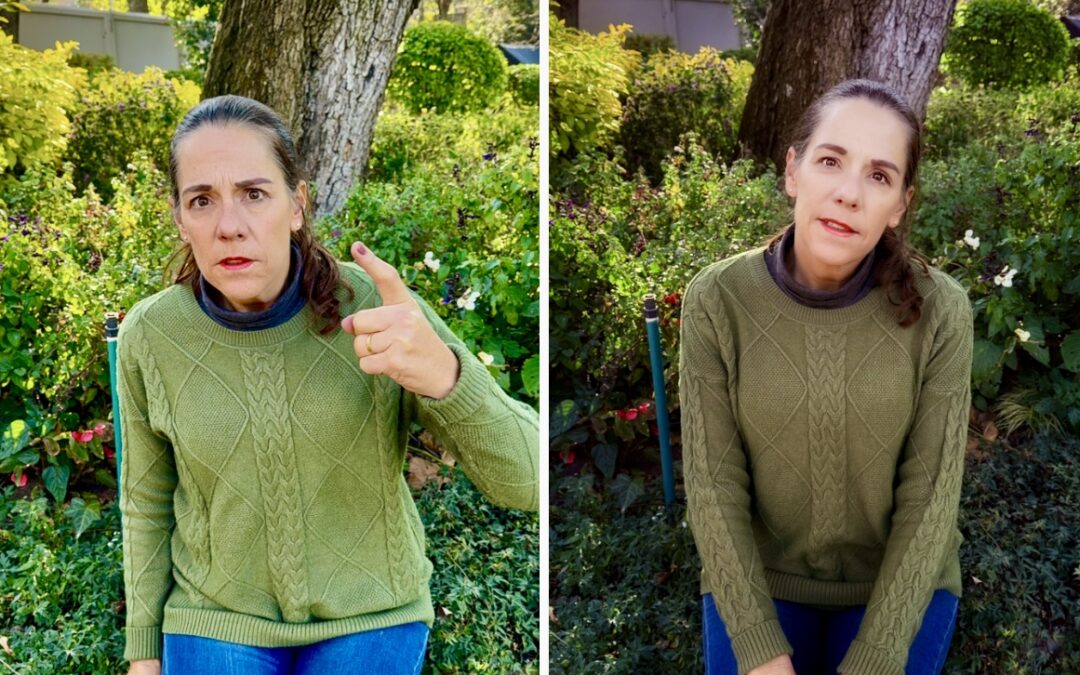
Hello there and welcome to my 120th blog.
It has taken me a long time to write this blog. I have been working on several ones, but none have reached fruition, for various reasons.
We now, fortunately and eventually, have lift off.
Reaction versus response. Boy oh boy!
Reaction is instant, automatic, and emotional. Someone criticizes you, and you snap back defensively, without thinking.
Response is thoughtful, intentional, and conscious. Someone criticizes you, and you take a breath, consider their point, and calmly reply, or choose to let it go.
No prize for guessing what I do, mostly, particularly of late when I have reacted rather than responded ninety percent of the time, and often it has not been pretty. It seems lame to find reasons for my behaviour, but the bottom line is that it is not at all cool, for me, or for the person or people on the receiving end of this.
I watch and admire, and, frankly, get a little envious of those folk who manage to exude this calm, grounded presence in all, if not most, circumstances. They never lose their cool, never raise their voices, and always seem to be totally in control. They just give off this air of calmness and serenity.
Not me, not by a long mile. I am a bit much, rather manic, overly energetic, and certainly, and definitely not, chilled. I speak too much, am often loud, and can be somewhat over the top. Here, I must say, I am not woe-ing is me, just sharing some of my thoughts.
My modus operandi goes a bit like this, with some variations along the way.
When someone says something that upsets me or I feel wronged or unsure, Boom, I just shoot straight from the hip. I let them know exactly how I feel, often gesticulating wildly, and with an obviously cross face. In the heat of the moment and with emotions running high, things do not always go so well. This is frequently not helpful, and I am not particularly nice. Sometimes it feels good in the moment (all five seconds of it), but that is short lived, and what follows this… guilt, distress, stress and anxiety… is just no fun at all.
This has been really really shocking of late as I have been tasked (involuntarily) with taking care of someone close to me. It’s unnecessary to bore you with the details but suffice it to say, I have been one hundred percent reactive. I feel that I have been the worst possible version of myself, and it’s been horrid for all concerned.
My ongoing mission of acts of kindness, in this department, has also fallen by the wayside, which stresses me further.
It has not taken me long to realize that I need to try to stop this behaviour, or even just curb it, somewhat.
Having read a little, and contemplated a lot, I have been on the learning curve again.
Let’s start with the neuroscience of reacting versus responding.
When we react, the more primitive part of our brain, which processes emotions, takes charge quickly. This is the amygdala which does not consider long term effects or rational thinking. It focuses on immediate survival and quick responses to apparent threats.
On the other hand, when we respond, the area of the brain associated with decision-making and social behaviour takes the lead. This is the prefrontal cortex which allows us to weigh options, think about consequences, and make choices based on reasoning, rather than emotion.
Now I need to learn to activate my amygdala!
In my reading, I stumbled upon the work of Brad Stulberg from The Growth Equation Academy. Immediately I knew that I had hit upon something that I could really work with.
His belief is that when something or someone happens, and we react, we panic and then proceed. For the most part, this is not good. If we choose to respond, when something or someone happens, according to Brad, it goes like this. We pause, process, plan, and then proceed, referred to as the 4 Ps.
Another useful tool he describes, is affecting labelling. Apparently labelling one’s emotions in stressful situations can lessen their power. So, I can say to myself “I am feeling anxious” or “I am frustrated” when something happens that upsets me. When one names the emotion, one activates the prefrontal cortex, as described above. At the same time, activity in the amygdala tends to decrease. This neurological shift helps one to control one’s emotional response, rather than be overwhelmed by it. This is definitely for me.
How can I aim to respond, as opposed to react?
Whether it is a carer who is rude to me, or a relative who is mean to me, or even if someone makes a throwaway comment, I can recruit the 4 P’s mentioned above.
- Pause
I can take a deep breath or two and gather myself. I can even say a quick mantra, like “It is okay, or I am okay.” I can even try to not think about what has been said for just a moment or three.
- Process
I can then label the emotions that I am feeling as described above. I may feel hurt, misjudged, cross, or upset. I can tell myself that I am doing the best that I can, I have choices, and I can manage the situation.
- Plan
When I have regrouped and collected myself. I can make a plan for what I want to do going forward. I can figure out what resources and skills I can bring to the situation.
- Proceed
After steps 1 to 3 have been completed, I can take action and proceed. I can choose to respond, or I can choose to remain silent. I can make the decision to be kind, too.
This seems so much easier said than done, however, I am determined to pursue this responding narrative.
Watch this space.
The swearing will be thrown out the window.
The sarcastic and cutting comments will disappeared.
The passive aggressive story will be no longer.
There will be no rection, just response.
Here comes the future Hayles, supremely calm, totally serene, indefatigably unflappable, and beyond tranquil.
In the meantime, as we wait in anticipation, I would like to wish you all a wonderful week ahead.